



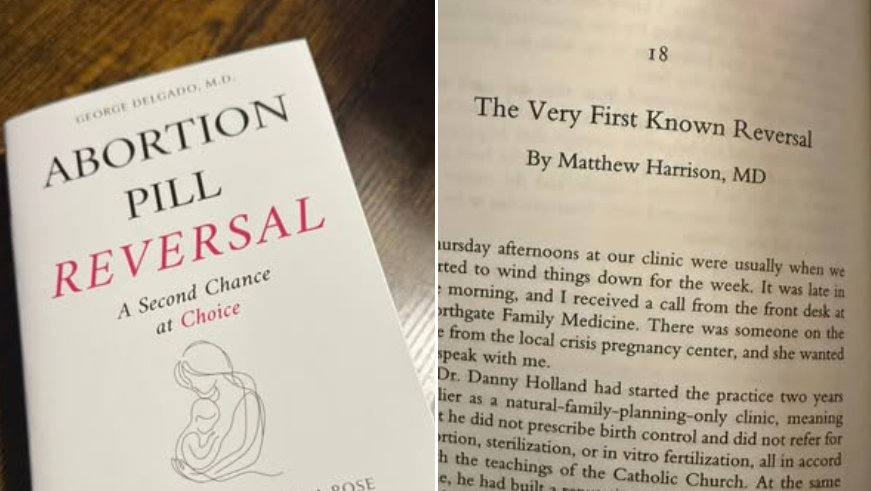
The physician who performed the first confirmed successful Abortion Pill Reversal (APR) is sharing his story with pioneering APR as part of a new book on the treatment that has saved thousands of lives.
Dr. Matthew Harrison contributed a chapter to Dr. George Delgado’s new book, Abortion Pill Reversal: Second Chance at Choice, telling the story of the first documented reversal of chemical abortion drugs.
Harrison, an M.D., is a hospitalist who serves in several hospitals in the Charlotte and western North Carolina areas. He also has a charity clinic that provides free prenatal care, supervises a nurse practitioner at an area college student health clinic, is an adjunct clinical professor for an osteopath medical school, and serves as president of his local Catholic Medical Association chapter. Harrison is an APR provider and medical director for a few pregnancy help centers where APR is offered as well.
He, along with Delgado and others, serves as a medical advisor for the Abortion Pill Rescue Network (APRN), an international network of providers and centers that includes nearly 1,500 healthcare professionals, pregnancy centers, and hospitals.
As an advisor for the APRN Harrison answers questions from the network regarding protocols and helps to train new providers.
He also gives talks at various conferences and has testified before legislatures in several states on informed consent laws for using Abortion Pill Reversal.
[Click here to subscribe to Pregnancy Help News!]
Abortion Pill Reversal is an updated application of a treatment used since the 1950s to combat miscarriage. It entails prescribing a bio-identical version of progesterone, the natural hormone in a woman’s body necessary to maintain pregnancy, to counter the effects of mifepristone, the first of two drugs in a chemical abortion.
Mifepristone blocks the progesterone in the mother’s system, starving the unborn child of nutrients. A day or so later, the second drug, misoprostol, is taken, prompting the mother to go into labor and deliver her presumably deceased child.
All major studies show that using progesterone to counteract an in-progress chemical abortion can be effective since it’s bio-identical to the hormone a woman’s body produces to sustain her pregnancy.
Tweet This: All major studies show that using progesterone to counteract an in-progress chemical abortion can be effective.
Abortion proponents have worked diligently in the legal, legislative, and medical fields, along with public campaigns to discredit and quash APR and its mention.
The protocol has remained front and center in the abortion debate with chemical abortion having become the large majority of abortions and consequently more and more women taking the drugs and having regret.
If a woman has taken mifepristone and acts quickly enough, it may be possible to save her unborn child. Results are best within 24 hours; however, successful reversals have occurred as long as 72 hours following the woman ingesting mifepristone.
A 2018 peer-reviewed study showed positive results with APR, including 64%-68% of the pregnancies saved, no increase in birth defects, and a lower preterm delivery rate than the general population.
Around 200 women call the APRN each month and start Abortion Pill Reversal, resulting in an average of six starts a day. Statistics show that more than 7,000 lives have been saved through APR.
Harrison himself has treated 16 or 17 women with Abortion Pill Reversal with an approximate 70% success rate, which is right around the average rate for successful reversals.
Still, it is the human component of this work that stands out for him.
Harrison has been able to remain in contact with some of the APR moms he has treated through social media, and he is happy to see them going about living their lives after successfully reversing their chemical abortions. He told Pregnancy Help News he feels like he is using his vocation and calling as a physician in an active way to fight abortion “rather than sit back and hope for the best.”
“I love this area of my work because it is a positive thing that we can do towards helping women correct a mistake that they have made,” he said. “It’s very rewarding to see these children and the mothers succeed over time.”
Both Harrison and Delgado are “pioneers” of the APR protocol, with Harrison performing the first known successful reversal in the eastern U.S. and Delgado forming the network from the west coast, each doing so independently and unaware at first of what the other was doing. Now, they both serve the APRN, and advocate for reversal.
Harrison said he was honored to contribute a chapter on the first known reversal for Delgado’s book.
“I hope this book educates widely about this wonderful protocol that has saved over 7000 babies from the abortion pill,” he posted on social media.
Harrison performed the first reversal in 2006, and the baby was born in March 2007. A few months after that, the information was first published on the Priests for Life website, where the original article from 2007 is still available.
The mother was a 19-year-old who had taken the abortion pill 36 hours prior to Harrison seeing her. He was called by a local pregnancy center where she had gone to get help. She was about 7-1/2 weeks pregnant.
“I started the progesterone treatment with injections,” Harrison recounted.
Eighteen years ago, he said they would have happened to have progesterone injections in their office for fertility care. So, for the first few years of APR injections was the main delivery method, he explained, but over time has been replaced with pills and vaginal suppositories.
Harrison’s patient started to bleed the next day, he said, and an ultrasound confirmed she was in danger of the abortion completing, but the hemorrhage mended.
“However, this healed over the weekend,” he said, “and we continued progesterone shots and she delivered a healthy baby at 40 weeks.”
“The little girl just turned 18 this past March,” said Harrison.
Delgado, without hearing about Harrison’s clinical case, also produced the same treatment about 18 months after Harrison had done his. And then he, along with Dr. Mary Davenport, an OB-GYN in the area, established and built the APR Network.
Delgado and Davenport contacted Harrison in 2011 about publishing his case report along with five other case reports of women who had attempted to reverse their abortions, Harrison said. This was published in the December 2012 edition of Annals of Pharmacotherapy.
“We started to work together to promote and build the network,” Harrison said.
“We both have been giving many talks about Abortion Pill Reversal, so we tend to divide up conferences that way,” he added.
Delgado transferred the APRN to pregnancy help network Heartbeat International in 2018.
Currently, Heartbeat, other networks and some pregnancy help centers are being sued by the attorneys general from California and New York, both who are vocal abortion proponents, over sharing information about Abortion Pill Reversal. The openly pro-abortion American College of Obstetricians and Gynecologists (ACOG) has denigrated APR as not supported by science.
Pro-abortion doctors have attempted to debunk APR, abortion-supporting politicians have publicly besmirched the protocol, certain states have attempted to quash the protocol, big tech has helped suppress it. One widely cited study, "Blocking Mifepristone Action With Progesterone," was intended to disprove APR but did it not and in actuality, demonstrated the dangers of the abortion pill, and the media still reports favorably on this.
A doctor in the UK has been threatened with losing his medical license for providing the treatment to women, and been assailed by mobs at speaking engagements.
Harrison takes particular issue with these efforts on the part of medical personnel.
“It’s very disappointing to see other healthcare professionals, using very unscientific methods to attack our protocols, and also to deprive women of the choice of reversing their abortions,” he told Pregnancy Help News. “They have even performed research studies that have substantiated our claims but then twisted the data interpretation to say that our protocols are dangerous, when it is actually the abortion pill itself that is dangerous.”
He defaults back to the service to women in providing Abortion Pill Reversal.
“I’ve also seen many women who avoided the guilt associated with aborting their children by attempting this reversal,” Harrison said. “Even if they have failed in reversing the abortion, at least they been able to tell themselves that they tried to help their baby.”
Editor's note: Heartbeat International manages the Abortion Pill Rescue® Network (APRN) and Pregnancy Help News. Heartbeat is currently the subject of two lawsuits brought by state AGs concerning sharing information on Abortion Pill Reversal. Abortion Pill Reversal: A Second Chance at Choice is available HERE and HERE.