



For years, Planned Parenthood has hyped the purported threat of its impending collapse. We have been told that federal funding cuts would devastate abortion access, that facility closures would leave women without “care,” and that political opposition would cripple the abortion provider’s ability to operate. Yet Planned Parenthood’s own annual reports tell a very different story. Far from shrinking, the abortion giant is evolving and doing so in a way that raises serious questions about both its priorities and its public messaging.
Start with the most striking number: abortions. Planned Parenthood’s latest annual report shows that the organization performed 434,450 abortions in 2024–2025, up from 402,200 the previous year. That is an increase of more than 32,000 abortions in a single year, roughly an 8% jump. At the same time, the number of patients served remained essentially unchanged, increasing only from 2.08 million to 2.09 million. The implication is difficult to ignore. Planned Parenthood is not reaching significantly more women. It is performing significantly more abortions on roughly the same population.
Other data points reinforce that shift. Preventive services are declining, with cancer screenings dropping from 364,600 to 331,400 year over year. Miscarriage care has also declined sharply.
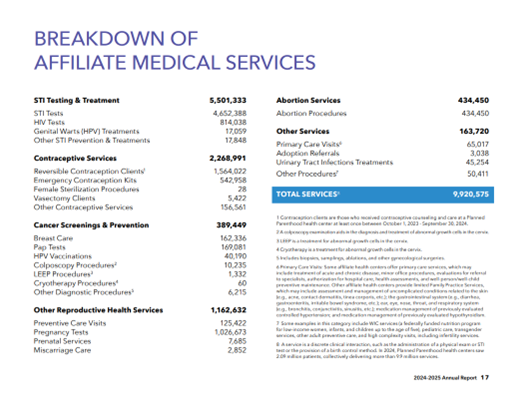
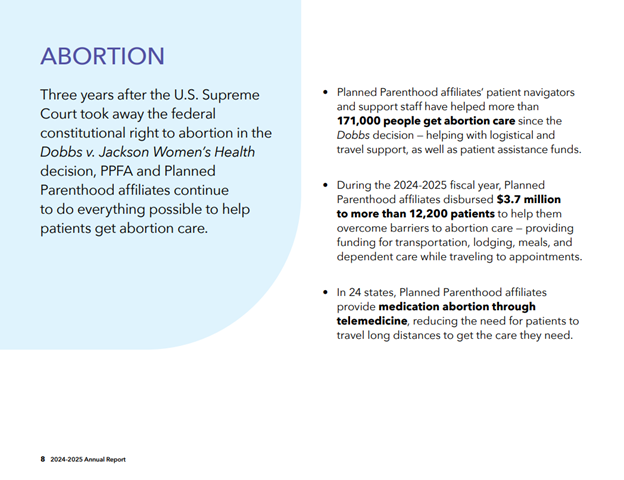
Meanwhile, telehealth appointments more than doubled, rising from about 142,000 to over 320,000, reflecting a rapid move toward remote, medication-based abortion. Planned Parenthood itself highlights that abortion can now be delivered through telemedicine in multiple states, reducing the need for in-person visits and expanding reach through digital platforms.
[Click here to subscribe to Pregnancy Help News!]
Perhaps the most significant contradiction lies not in services, but in finances. Despite repeated warnings of “defunding” and existential threat, Planned Parenthood’s financial position remains remarkably stable. The organization reports total assets of approximately $3.12 billion one year and $3.11 billion the next, a negligible change that signals stability rather than strain. At the same time, donor revenue is increasing, now accounting for approximately 91% of national revenue, up from 88% the previous year. In other words, fundraising is not declining. It is growing, fueled in part by the very narratives of crisis that dominate its public messaging.
That stability is reflected at every level of the organization, including executive compensation, where top leadership earns salaries more consistent with a thriving national enterprise than one on the brink of collapse.
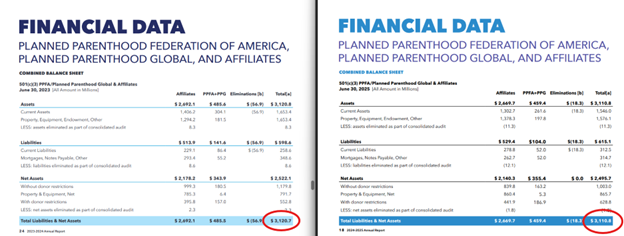
Government funding also remains embedded in its operations through reimbursements and grants, with no evidence in the report of a dramatic drop. Yet in the same document, Planned Parenthood warns that up to 200 health centers are at risk of closure due to policy changes. That tension between narrative and numbers is striking. If the organization were truly being dismantled, we would expect to see declining services, shrinking assets, or reduced output. Instead, we see the opposite.
What the data actually suggests is not collapse, but consolidation. Planned Parenthood is increasingly shifting away from a traditional, localized clinic model toward a more centralized, digitally driven system. Telehealth platforms, medication abortion, and national coordination networks are reducing the need for brick-and-mortar locations while expanding overall reach. In that context, clinic closures are not necessarily signs of distress. They may be part of a broader effort to reduce overhead, streamline operations, and increase efficiency.
The report itself offers a telling example. On page 8, Planned Parenthood highlights that during the 2024–2025 fiscal year, its affiliates disbursed $3.7 million to more than 12,200 patients to help them travel for abortion care, covering transportation, lodging, meals, and dependent care. This is not the language of an organization in retreat. It is the language of one actively investing in a coordinated, nationwide abortion access strategy.
The results are clear. More abortions. The same number of patients. Stable finances. Growing donor support. This is not an organization running scared. It is an organization refining its model.
Tweet This: The results are clear. Planned Parenthood provided more abortions to the same number of patients. This is an organization refining its model
There is also a deeper issue at stake. Planned Parenthood has long insisted that abortion is a small part of what it does, often pointing to the volume of other services to support that claim. But the trend lines tell a different story. Abortion numbers continue to rise, even as services like cancer screenings and miscarriage care decline and prenatal care remains minimal. If abortion were truly peripheral, it would not be the category consistently growing while others fall away. This is not a neutral development. It reflects where the organization is placing its emphasis.
Planned Parenthood’s own reports show a narrowing focus, one in which abortion is not simply one service among many, but an increasingly central component of its operations. That may be a strategic decision, but it is one that deserves to be acknowledged honestly.
The public conversation around Planned Parenthood has often been shaped by emotion and political rhetoric. What is needed now is clarity, and clarity begins with the numbers. Planned Parenthood says it is under attack. Its own reports say it is thriving. At some point, the narrative has to give way to the reality of the numbers.